


Concept for early language support in German
Foreword: Language development – the language tree
Children need language always and everywhere: whether living together in the family or in day care.
The foundations for this are laid in the first years of life. That is why early language development is important. Whether it is vocabulary expansion, sentence formation skills, communicative competence or singing, all these points are indispensable in language development. Language development always requires holistic learning, preferably with all the senses.
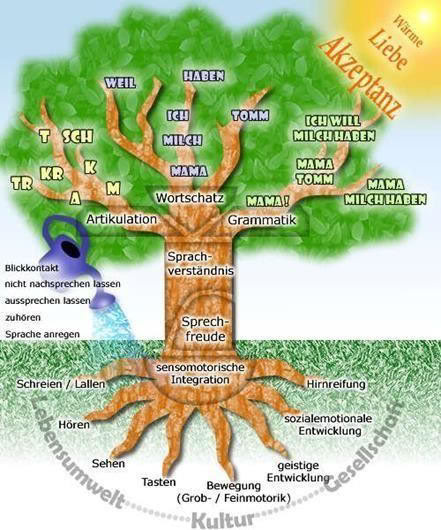
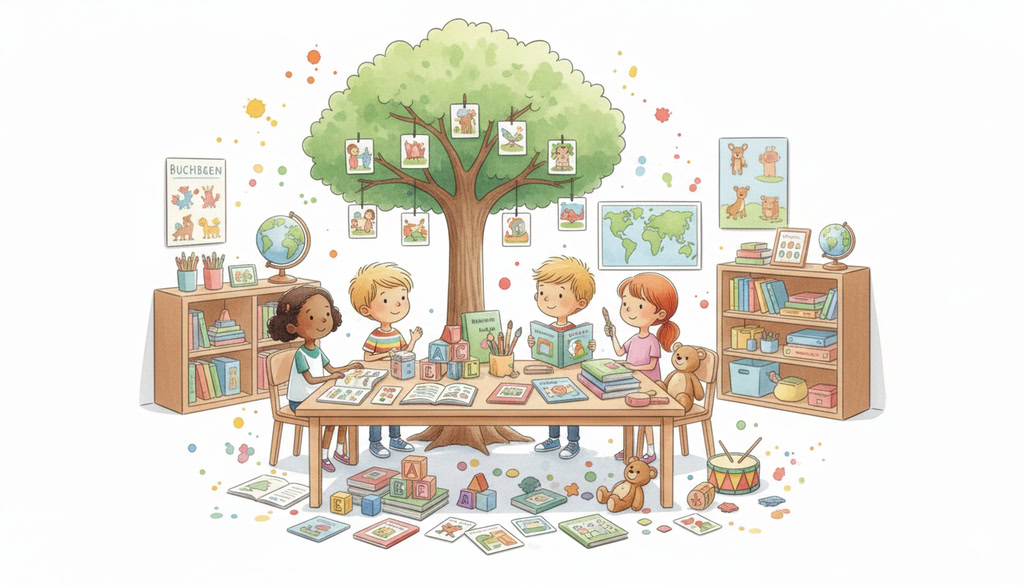
The language tree symbolises the factors that influence language development in children. Although language acquisition proceeds in a similar way for all children, it happens at different speeds and with individual variations, e.g. in vocabulary acquisition. Like every child, the language tree is unique.
1. Requirements of the Canton of Basel-Stadt – Ordinance on early
Legal provisions of the canton of Basel-Stadt provide the framework for early German language support: https://www.gesetzessammlung.bs.ch/app/de/texts_of_law/415.100 (Canton of Basel-Stadt)
Requirements from the Department of Education of Basel-Stadt Centre for Early Support: https://www.jfs.bs.ch/fuer-familien/geburt-und-kleinkind/vor-dem-kindergarten/obligatorischedeutschfoerderung.html
"Early German language support is an important pillar of early support. German language skills are of fundamental importance for the developmental biography of children. They form the basis for later educational success and integration."
2. Early German language support programme at St. Leonhard day care centre
2.1 Objective of early German language support
The St. Leonhard Day Care Centre creates and optimises the conditions for early German language support and provides the necessary resources. Parents are encouraged to ensure that their children increasingly develop the foundations for later educational success and integration into the community.
2.2 Benefits of early German language support
Early German language support at the St. Leonhard day care centre is designed to help children increasingly develop the foundations for later educational success and integration into the community. In this way, language development can contribute to the well-being and holistic development of children.
2.3 Qualified specialist in early German language support
One member of the teaching team has completed training in early German language support and isresponsible for early German language support at the St. Leonhard day care centre.
3. Resources
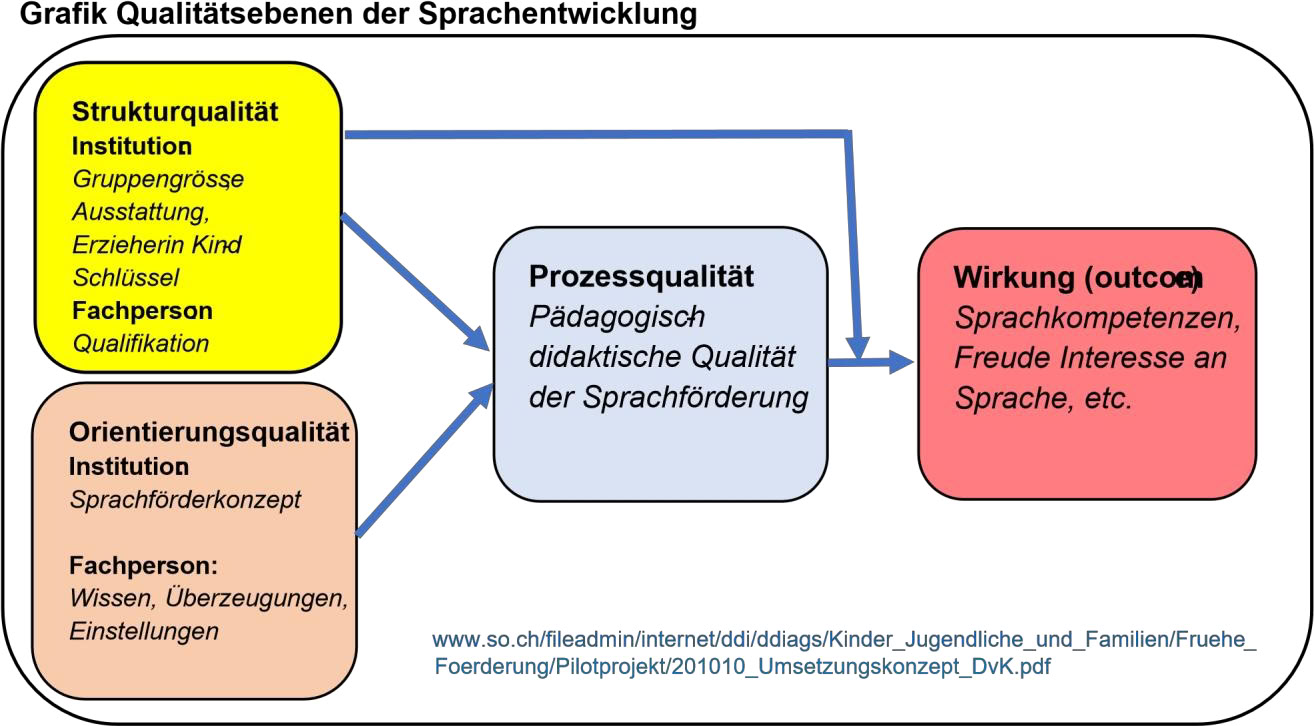
The day care centre creates the conditions and resources necessary to enable the required quality of early language support in German (see diagram below):
3.1 Structural quality:
In cooperation with the Day Care Department of the City of Basel-Stadt, the board creates the necessary conditions, group size, equipment and staff-to-child ratio to be able to provide early German language support of the required quality.
3.2 Orientation quality:
The concept of early language support in German at the St. Leonhard day care centre.
3.3 The specialist:
Early German language support specialists have completed training in early German language support and have the necessary pedagogical and didactic skills, knowledge, convictions and attitudes.
4. Role of the specialist in early German language support
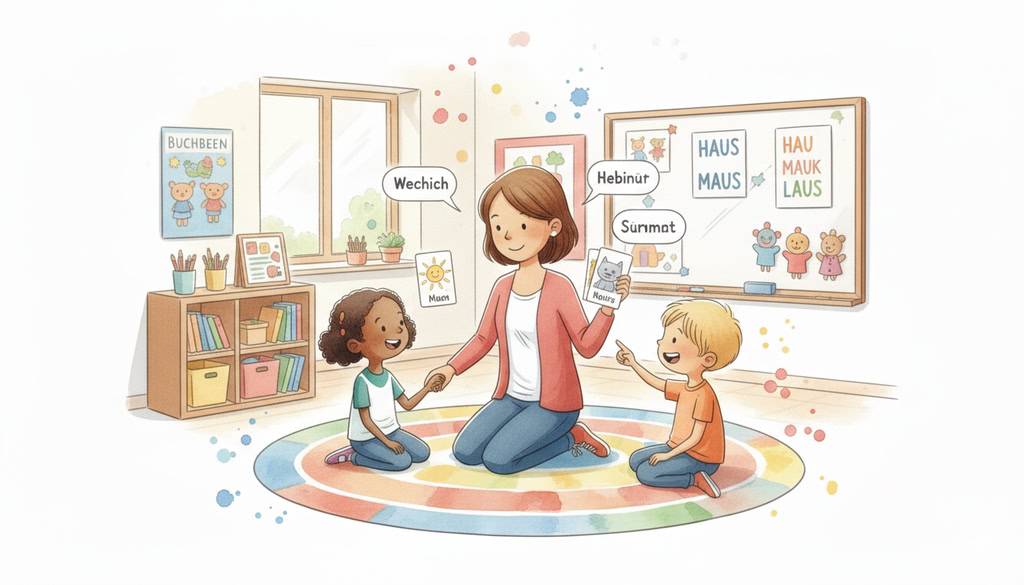
Functional objective and benefits of the specialist in early German language support Specialist (FFSD) plans and organises goal- and needs-oriented the pedagogical and didactic implementation of German language support for pre-school children who require special language support. Parents are encouraged to ensure that their children increasingly develop the foundations for later educational success and integration into society.
Leadership / support and assurance from the home manager through regularly scheduled management meetings in which success is determined and challenges are clarified, how conflicts can be resolved, evaluate results, discuss further assignments
5. Pedagogical and organisational principles of early language support
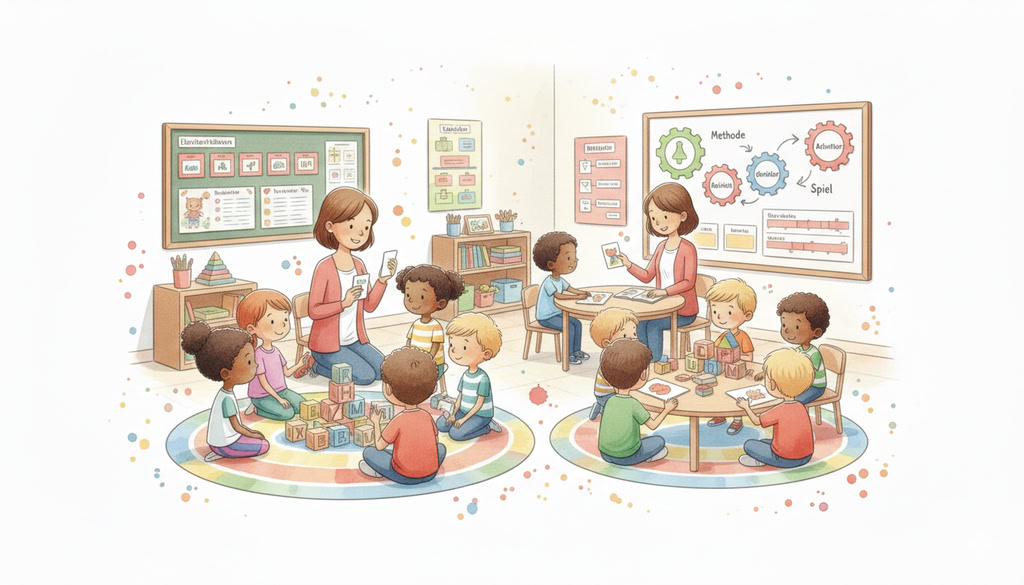
Early language support at the St. Leonhard day care centre is based on clear educational principles and transparent organisational structures. Both areas are interlinked and form the basis for highquality, sustainable language support practices.
5.1 Educational principles
5.1.1 Child-centred and individual support
Every child has their own language history, different resources and an individual pace of development. We meet the children where they are and support their language development in a resource-oriented, sensitive and developmentally appropriate manner.
5.1.2 Language support integrated into everyday life
Language support takes place in all situations of everyday life at the nursery. Care situations, play times, mealtimes and transitions are specifically used to stimulate, model and expand language.
5.1.3 Relationships as the basis for language development
A secure bond and an appreciative relationship are central prerequisites for successful language acquisition.
5.1.4 Dialogic interaction
Children learn language through genuine interaction. Educational specialists engage in dialogue, ask open questions and respond to children's impulses.
5.1.5 Multilingualism as a resource
All family languages are valued. The child's first language is important for identity and cognition. Swiss German is promoted as the common everyday language, without devaluing their languages of origin.
5.1.6 Participation and co-determination
Children are involved in decisions that affect their everyday lives. Through co-determination, they experience self-efficacy and at the same time expand their language skills.
5.1.7 Structured and targeted support
In addition to everyday support, regular, short, child-friendly language support sequences (songs, rhymes, picture books, language games). These are based on observations, documentation and defined support goals.
5.2 Organisational principles
5.2.1 Clear responsibilities
Responsibility for early language support is clearly defined:
- The language support specialist plans, monitors and evaluates the support.
- The group leaders implement language support measures in everyday life and exchange ideas with each other.
- The educational management ensures the framework conditions, resources and quality assurance.
5.2.2 Binding procedures and transparent structures
Language support follows clearly defined steps:
- Observation and assessment of language development
- Derivation of individual support goals
- Planning of targeted measures integrated into everyday life
- Implementation in group activities
- Documentation of development
- Reflection within the team and with management
- Communication with parents (annual parent-teacher meetings, informal chats)
5.2.3 Regular internal communication
At least once a month, there is an exchange between the language support specialist and the groups.
Contents:
- Children's stage of development
- Difficulties or progress
- Support planning
- Organisation of materials and space
5.2.4 Cooperation with parents
Parents are provided with transparent information about language development, observations and support goals. Discussions are structured and based on an appreciative and participatory approach.
5.2.5 Documentation and quality assurance
- Children's stage of developm
- Language observations and support measures are documented on an ongoing basis.
- The language support concept is reviewed and adapted at least once a year.
- Further training for the team ensures that all employees act in a way that promotes language development.
5.2.6 Organisation of space and materials
The environment is designed to promote language development:
- a variety of materials (books, pictures, games)
- quiet conversation areas
- visual aids (symbols, picture cards)
An orderly environment supports understanding and promotes communication processes.
6. Early language support in German at the St. Leonhard day care centre
6.1 Guiding principle
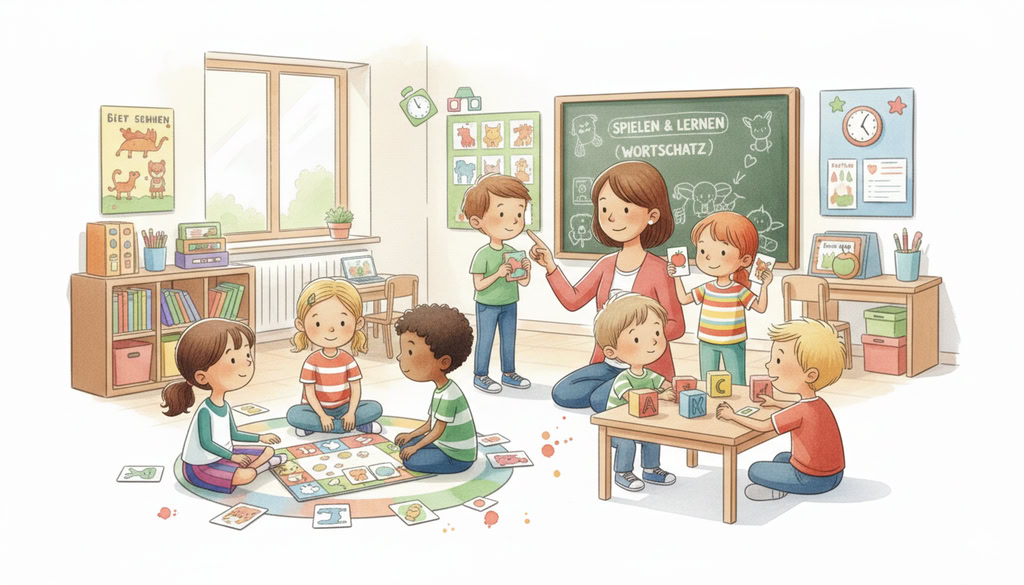
Language is omnipresent in everyday life – when playing, eating, getting dressed, laughing and discovering new things.
Our educational approach is based on the conviction that language development should not be isolated, but rather integrated holistically into everyday life, both consciously and unconsciously. Every child brings their own individual language history with them – we meet them where they are.
6.2 Integrating language into everyday life:
We promote language development in a situational, dialogue-based and child-centred manner.
- When getting dressed: naming items of clothing, colours and sequences ("First the socks, then the shoes")
- When eating: talking about taste, quantities and independence ("Can I have some more?" – "Can I serve myself?")
- During free play: stimulation through role-playing, verbal conflict resolution, asking questions
- During morning circle or show-and-tell: space for stories, announcements, songs
The children are always actively involved and encouraged to express their opinions, make suggestions or share experiences. This not only promotes their language skills, but also their selfconfidence and participation.
6.3 In addition, we focus on the following areas:
- We facilitate and protect conversations among children by giving them sufficient time and space to develop their thoughts through interaction with each other. Games and conversations that are going well are not interrupted prematurely.
- Children are given targeted support in their conversations with others: if necessary, we moderate, clarify misunderstandings or encourage reflection. We then consciously withdraw in order to strengthen the independence of the interaction.
- We pay attention to the quality of the interaction: conversations are deliberately framed and guided by questions or prompts so that children can more easily contribute their own thoughts.
- We explain unfamiliar words with language, gestures and facial expressions. If linguistic means of expression are lacking, we offer alternative formulations.
- We respond to the children's interests, listen actively and give them enough time to express themselves.
- Children who listen are included in the conversation, for example by giving feedback or sharing their own experiences.
- Conversations are deepened with follow-up questions so that children expand their thinking and learn new perspectives.
6.4 The aim of language support
- To expand vocabulary
- To promote language comprehension and expressive ability
- Strengthen communication skills
- To value multilingual resources
6.5 How we do it
In addition to everyday language support, weekly language support sessions are held in small groups. These are tailored to the individual developmental stages of the children and include:
- Language games
- Picture book viewing
- Rhymes, songs, finger games, stories
- Storytelling circles and dialogues
These sequences are systematically documented. The basis of our targeted language development is observation using the Sismink model and the language development observation sheet by Kornelia Schlaaf-Kirschner. Language development is a continuous process, which is why we regularly reflect as a team on:
- Review the impact of previous measures
- Exchange observations
- Planning the next steps together
6.6 Multilingualism and German language support
Swiss German is the everyday language at our daycare centre. The aim is for all children to be able to communicate in Swiss German so that they can participate in social interaction and successfully pursue their further education. Early compulsory language support is therefore a central component of our educational work.
We believe that multilingualism is beneficial for children and that their first language forms an important basis for their identity and emotional security. That is why we teach the children that multilingualism is a positive thing – but German is our common language at the daycare centre.
6.7 Language support in everyday life
- Language development takes place in a situational, dialogue-based and child-centred manner in all everyday situations (when getting dressed, eating, in the morning circle, during play, etc.).
- Children with little knowledge of German are given targeted support by offering them clear linguistic models, explaining unfamiliar words and using gestures/facial expressions for clarification.
- We pay particular attention to ensuring mutual understanding. Children are encouraged to use new words, ask questions and participate in conversations.
- Children's conversations are facilitated and accompanied: we provide linguistic support and moderate when necessary, but withdraw as soon as the children start talking independently.
6.8 Communication with parents
In parent-teacher meetings, we make it clear that Swiss German is spoken at the nursery so that the children can experience and use the language intensively in everyday life. At the same time, we encourage parents to use their own family language/national language at home. This helps parents understand that their child needs both languages:
- German, in order to participate in nursery and later in school
- and the family language to build a stable identity, bond and language foundation.
This clear stance shows both children and parents that multilingualism is valued, while at the same time placing the promotion of German at the centre of our educational work.
7. Tasks of the early German language support specialist
7.1 Needs-oriented and autonomy
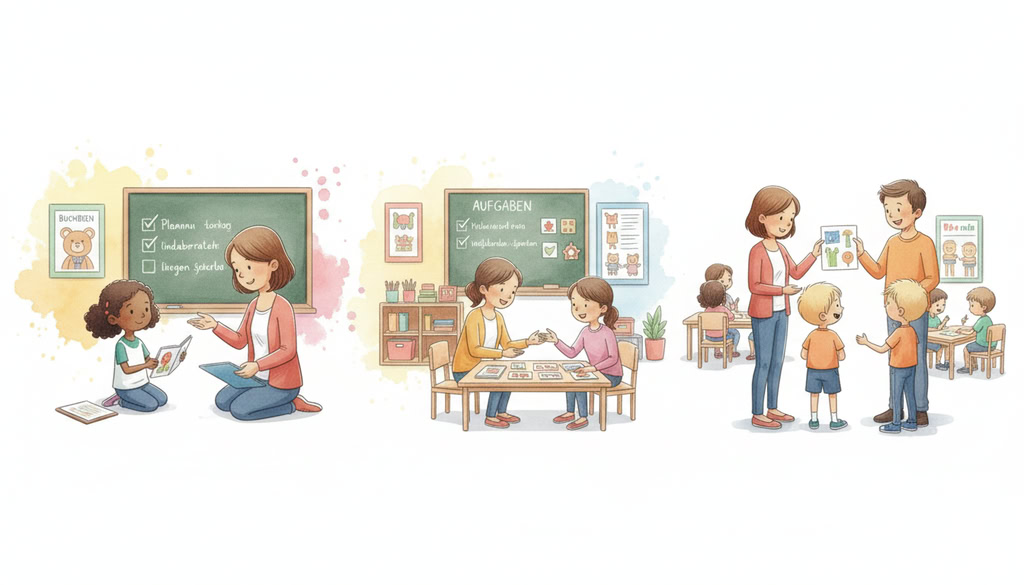
Taking into account the individual needs and interests of children when designing language support activities. Creating a supportive environment that enables children to explore and develop their language skills independently. This can be achieved through open play and learning opportunities and by promoting self-expression and self-confidence.
7.2 Learning environment
Language is used everywhere in everyday life, from morning (when the children arrive) to evening (when they leave). That is why it is important to use modelling techniques to engage with and support each child at their own level of language development at any given time.
Create an environment that is rich in language stimuli and offers opportunities for diverse social interactions, especially with caregivers and peers.
Combine language development with other activities and integrate it into the daily routine, e.g. during meals, play, tidying up and excursions. These offer a variety of opportunities for linguistic interaction.
Caregivers use rich and varied language in their interactions with children and offer them a wide range of language experiences through songs, rhymes, reading aloud/storytelling, role-playing and conversations.
Integrate seasonal themes and projects into language-promoting activities in order to to give children a holistic understanding of language and culture. This can include seasonal songs, stories, crafts and cooking activities that expand vocabulary and promote cultural understanding.
7.3 Individual and group support
Children are supported in small groups or individually in overcoming their specific language challenges.
The individual needs and interests of the children are taken into account when designing language support programmes.
Rich and differentiated language is used when interacting with the children, and they are given a variety of language experiences through songs, rhymes, stories, role-plays and conversations.
Cross-group activities
Conducting language support activities in mixed groups to promote social interaction and peer learning. Children of different ages and developmental stages can learn from and support each other as they work together on language challenges.
7.4 Regularly scheduled sequences
Planning regular language support sequences in small, manageable groups of children to promote individual attention and interaction. The groups are deliberately kept small so that each child receives sufficient support. If necessary, 1:1 support is also offered in order to respond specifically to the individual needs of each child. These sequences can include various activities such as language games, reading times, story times, rhyming and singing lessons, as well as creative activities that support language development.
7.5 Communication with parents
We strive to maintain open and regular communication with parents in order to involve them in and support their children's language development. Parents are encouraged to actively participate in their children's language development by playing language games at home, reading aloud, reading together and talking about everyday life. Above all, they are encouraged to speak the family language, which may also be the native language of the parents and children. This close cooperation between the nursery and parents ensures the continuous development of all the children's language skills, both at the nursery and at home.
7.6 Involvement of the team
The educational team is actively involved in the planning, implementation and evaluation of language support measures. Regular team meetings and training courses are used to exchange ideas, share best practices and develop new approaches together. This cooperative approach strengthens the commitment and effectiveness of language support across the entire team, which ultimately benefits all children.
7.7 Evaluation of results
Regular evaluation of language support measures to ensure that they meet the needs of the children. Based on observations and feedback, adjustments should be made to continuously improve the effectiveness of language support and ensure that all children receive the best possible support.
Quality assurance
The quality of language support in our nursery is ensured through various measures:
- Regular team meetings: The teaching team regularly reflects on everyday life, the methods used and the children's progress. Experiences are shared and improvements are decided upon together.
- Further training: Employees regularly take part in internal and external further training courses to keep their knowledge of language development and multilingualism up to date and to bring new ideas into practice.
- Supervision and intervision: External and internal reflection forums provide space to discuss challenging situations, review one's own attitude and continuously develop educational work.
- Close cooperation with external agencies: We maintain a continuous exchange with specialist agencies such as the Early Intervention Centre (ZFF) and with kindergartens. This enables us to develop a common approach and coordinate and effectively anchor language support beyond the nursery. and effectively anchored.
- Concept review: The language support concept is reviewed at fixed intervals and adapted as necessary to ensure that it meets current educational, legal and social requirements.
- Exchange with parents: Feedback from parents is recorded and incorporated into our reflections. This allows us to assess the impact of our language support from the parents' perspective as well.
The pedagogical concept and mission statement of the St. Leonhard Daycare Centre was reviewed by the daycare centre, Department of Education of the Canton of Basel-Stadt in terms of content and approved on September 2025.

Contact
© 2017-2026 Tagesheim St. Leonhard